Some stops on a Big Island itinerary are all about the beach. Others are all about the story. Pu’uhonua O Honaunau National Historical Park is the latter. This actually turned out to be one of the more noteworthy stops of our trip with a four- and six-year-old in tow.
We went in without huge expectations. A “historical park” doesn’t exactly scream toddler entertainment. But between the ancient stone walls, the carved wooden statues, and a genuinely fascinating backstory about escape and forgiveness, our boys were hooked almost immediately. They had question after question, which is always the best sign a place has landed with kids.
Quick facts:
- Location: Honaunau, Big Island, about 32 km (20 mi) south of Kailua-Kona
- Hours: Daily, 8:15 a.m. to sunset
- Cost: $20/vehicle, $15/motorcycle, $10/pedestrian or cyclist (valid 7 days, kids under 16 free)
- Time needed: 30–45 minutes with young kids, up to 2 hours if you go at a slower pace
- Good to Know: Two Step, one of the Big Island’s best snorkelling spots, is right next door
What You’ll Find in This Pu’uhonua O Honaunau National Historical Park Guide
This guide covers everything you need to decide if Pu’uhonua O Honaunau is worth adding to your Big Island itinerary with kids:
- The History: What “place of refuge” means and why the site mattered in ancient Hawaiian life
- What to Do: The ki’i, the Great Wall, the thatched hale, and the tide pools worth seeing
- What Grabbed Our Kids: The details that held a four- and six-year-old’s attention
- How Long to Stay: Realistic timing for young kids versus a slower-paced visit
- Tips for Visiting with Young Kids: What to bring and how to keep them engaged
- Hours, Tickets, and Cost: Everything you need to plan your visit
- Getting There: Directions and a map from Kona
- Two Step: The snorkelling spot right next door, and how it fits into your visit
- Our Final Thoughts: Do we think it’s worth visiting Place of Refuge with kids?
- Quick Answers: The most common questions about the park, Two Step, and visitor etiquette

Out Roaming Life contains affiliate links and is a member of the Amazon Services LLC Affiliate Program.
If you make a purchase using one of our links, we may receive compensation at no extra cost to you.
We only recommend products and services we trust. Read our disclaimer for more information.
The History of Pu’uhonua O Honaunau: What Does the Name Mean?
Pu’uhonua translates roughly to “place of refuge”. That name is the entire history lesson in a nutshell.
In ancient Hawaiian society, daily life operated under a strict code of conduct called the kapu system. Breaking a kapu, even by accident, could carry the penalty of death. A pu’uhonua was a sanctuary. If someone broke a kapu and managed to reach one before being caught, a priest could absolve them and they could return home safely. These sites also sheltered defeated warriors and civilians during times of war.
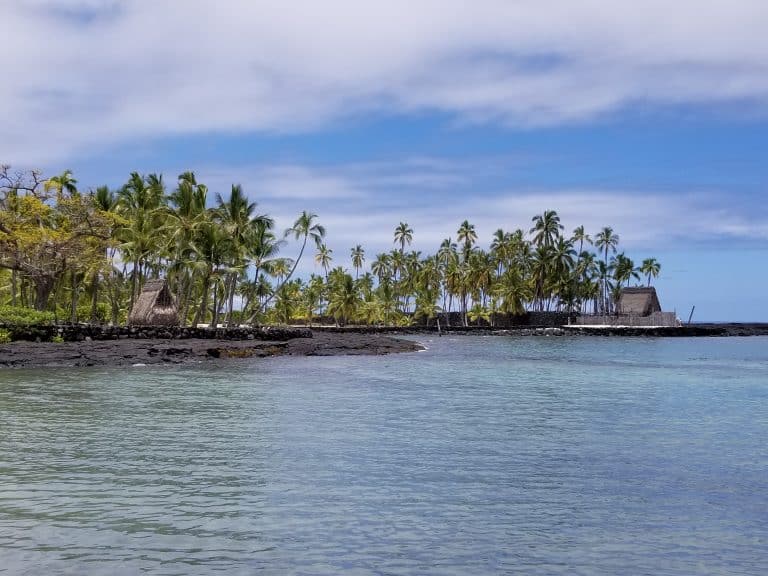
Honaunau’s pu’uhonua is one of the best preserved in Hawaii, and it sits right beside what was once a royal compound, separated from the sacred grounds by a massive stone wall built entirely without mortar. That wall is worth stopping at on its own, since the construction is pretty impressive up close.
What to Do at Pu’uhonua O Honaunau National Historical Park
This historical park is centred around a self guided walking trail that loops through the Royal Grounds and out to the coastline, so there isn’t a set order you have to follow. A few highlights worth building your visit around:
- The ki’i (carved wooden statues) that stand watch over Hale o Keawe, a reconstructed temple within the Royal Grounds. These were the single biggest hit with our kids.
- The Great Wall, a mortar-free stone boundary separating the royal grounds from the pu’uhonua itself.
- Thatched hale (traditional structures) built entirely from natural materials, a great visual for kids who like figuring out how things are made.
- Tide pools along the coastline, home to honu (Hawaiian green sea turtles) and worth a slow look (remember, no touching).
- A traditional kōnane playing surface, a carved stone board once used for a Hawaiian strategy game, tucked into the Royal Grounds.

Area of Place of Refuge That Grabbed Our Kids’ Attention
We expected our four-year-old to lose interest fast. Instead, the ki’i were what pulled him in first. He wanted to know why they looked fierce, what they were protecting, and whether they were “real” in some sense he was still working out. Our six-year-old asked more about the mechanics of the place: how the walls stayed up without cement, how old the carvings were, and how people would have known exactly where the boundary of the refuge stood.
We didn’t have every answer, and that was fine. Not knowing gave us a reason to look things up together afterward. If your kids are curious types, come prepared for a lot of “but why” moments, because this place invites them.

How Long to Spend at Pu’uhonua O Honaunau National Historical Park
We spent about 30 to 45 minutes here. This ended up being close to the right amount for our crew. Our kids started to lose steam right around the half hour mark.
If your kids are older, or you’re the type of family that likes to slow down and really absorb a place, you could easily spend closer to an hour, maybe two. Between the walking trail, the tide pools, and the sheer amount of history packed into a small footprint, a slower pace would reward you. For us, a brisk walk through with lots of pointing and question answering was the right call, and we still felt the stop was well worth it.
Tips for Visiting with Kids
- Go earlier in the day if you can. The grounds are mostly open with limited shade, and Big Island heat builds quickly.
- Bring water and snacks. There’s no food available on site.
- Embrace the walk. Much of the site is meant to be walked through rather than viewed from behind a rope, which makes it more immersive for kids than a typical museum stop.
- Frame it as a story before you go. A quick, simplified version of the kapu system and the idea of a “safe place” primed our kids to understand what they were seeing once we arrived.
- Keep tide pool time hands off. Kids will want to explore, but treat it as a look-only stop to protect the marine life.
- Keep your visit flexible. The site is compact enough that you can adjust your pace on the fly. If your kids are engaged, linger. If they’re fading, you can wrap up in well under an hour and still hit the highlights.
Pu’uhonua O Honaunau National Historical Park Hours, Tickets, and Cost
Place of Refuge is open daily from 8:15 a.m. until sunset, and the visitors centre operates from 8:30 a.m. to 4:30 p.m. daily. Note that the park gate closes 15 minutes after sunset.
Entrance passes are valid for seven days and priced per vehicle type:
- $20 for a private vehicle
- $15 for a motorcycle
- $10 for pedestrians or cyclists entering on foot or by bike
- Kids under 16 get in free
If you already hold an America the Beautiful annual or lifetime pass, or plan on picking one up for other national park stops on your trip, that covers your entrance here too, so there’s no need to buy a separate site pass.
Pu’uhonua O Honaunau National Historical Park Map and Directions from Kona
From Kailua-Kona, head south on Highway 11 for about 32 km (20 mi). Between mile markers 103 and 104, near the Honaunau Post Office, turn right toward the ocean onto Highway 160. From there it’s about 5.6 km (3.5 mi) to the park entrance sign on your left.
GPS coordinates for the park entrance: 19.4127, -155.9009.


Two Step: The Snorkelling Spot Right Next Door
If you’re travelling with a mix of ages or splitting up activities, it’s worth knowing that one of the Big Island’s best snorkelling spots sits just outside the park gates. Honaunau Bay, better known locally as Two Step, gets its name from a pair of natural lava steps that make for an easy ocean entry, something that’s rare on a coastline mostly made up of rugged lava rock.
Two Step isn’t part of the national historical park and has its own parking area just before the park entrance, so plan on a separate stop if snorkelling is on your list. Snorkelling directly inside the park at Keone’ele Cove isn’t permitted, which is part of why Two Step exists as its own well known access point right beside it.
Morning is the best time to go, since the water tends to be calmer and clearer before the wind picks up in the afternoon, and it’s a good spot for green sea turtle and dolphin sightings.
If you’re combining both stops in one outing, do the historical park first while everyone still has energy, then treat Two Step as the reward at the end.
Place of Refuge Visitors Centre
The visitors centre sits right near the entrance and is a good first stop for orientation, restrooms, and Junior Ranger booklets if your kids collect badges at national park sites. It’s a small building rather than a full exhibit hall, so don’t expect to spend a lot of time there, but it’s worth the quick pass through before you head out onto the grounds.
Frequently Asked Questions about Place of Refuge
What does Pu’uhonua O Honaunau mean? Pu’uhonua translates to “place of refuge.”
The site was a sanctuary where kapu breakers, defeated warriors, and civilians could seek safety under ancient Hawaiian law.
How much does it cost to get into Pu’uhonua O Honaunau National Historical Park?
Entrance is $20 per vehicle, $15 per motorcycle, or $10 per pedestrian or cyclist, valid for seven days. Kids under 16 get in free, and America the Beautiful passes are accepted.
How long should you spend at Pu’uhonua O Honaunau National Historical Park?
Plan on 30 to 45 minutes with young kids. Give yourself closer to one to two hours if you want to walk the full trail at a slower pace or spend time at the tide pools.
Is Two Step next to Pu’uhonua O Honaunau National Historical Park?
Yes. Two Step, also called Honaunau Bay, is a popular snorkelling spot located just outside the park gates, with its own separate parking area.
Can you snorkel at Pu’uhonua O Honaunau itself?
No. Ocean access for swimming, snorkelling, or diving isn’t permitted inside the park, including at Keone’ele Cove. Two Step, just outside the park boundary, is the designated spot for that.
Are pets allowed at Pu’uhonua O Honaunau?
Not in the Royal Grounds or the puʻuhonua itself. Leashed pets are permitted in the picnic area, and along the coastal and 1871 Trails.
What are some respectful practices to follow when visiting?
This is an active sacred site, not just a historic attraction, so treat it accordingly. Don’t touch, remove, or climb on the ki’i, walls, or other structures. Smoking, picnicking, sports, and beach gear (including towels) aren’t permitted on the grounds. Keeping voices low and moving slowly through the site goes a long way too.

Final Thoughts: Is Pu’uhonua O Honaunau Worth Visiting with Kids?
For us, yes, without hesitation. Pu’uhonua O Honaunau National Historical Park consistently ranks among the top rated attractions on the Big Island, and it’s easy to see why once you’re standing in front of the Great Wall or watching your kids admire a ki’i. It’s not a place that requires a full afternoon to appreciate, which made it an easy addition to a day that also included a stop at Ho’okena Beach Park.
Even in a short window, our kids walked away with real curiosity about Hawaiian history, and that’s exactly what we’re always hoping for when we bring them somewhere new. Sometimes the best family travel stops aren’t the ones built for kids. They’re the ones with a story compelling enough that kids lean in on their own.
Be sure to check out these posts for more kid-friendly ideas and itinerary planning:
- Best Beaches on the Big Island for Families? We’ve Got You Covered!
- Big Island Itinerary: How Many Days Do You Actually Need?
- Hawaii Travel Guide: Family Adventures, Tips & Budget Advice
If you’re looking for a meaningful stop to add to your family’s Big Island itinerary, one with real history and enough intrigue to hold a young kid’s attention, we hope this helps make your visit easier to plan. Please consider pinning it on Pinterest, saving it for later, and sharing it with anyone else dreaming of a Hawaii trip with their family.
Hawaii is the loveliest fleet of islands that lies anchored in any ocean.
Mark Twain